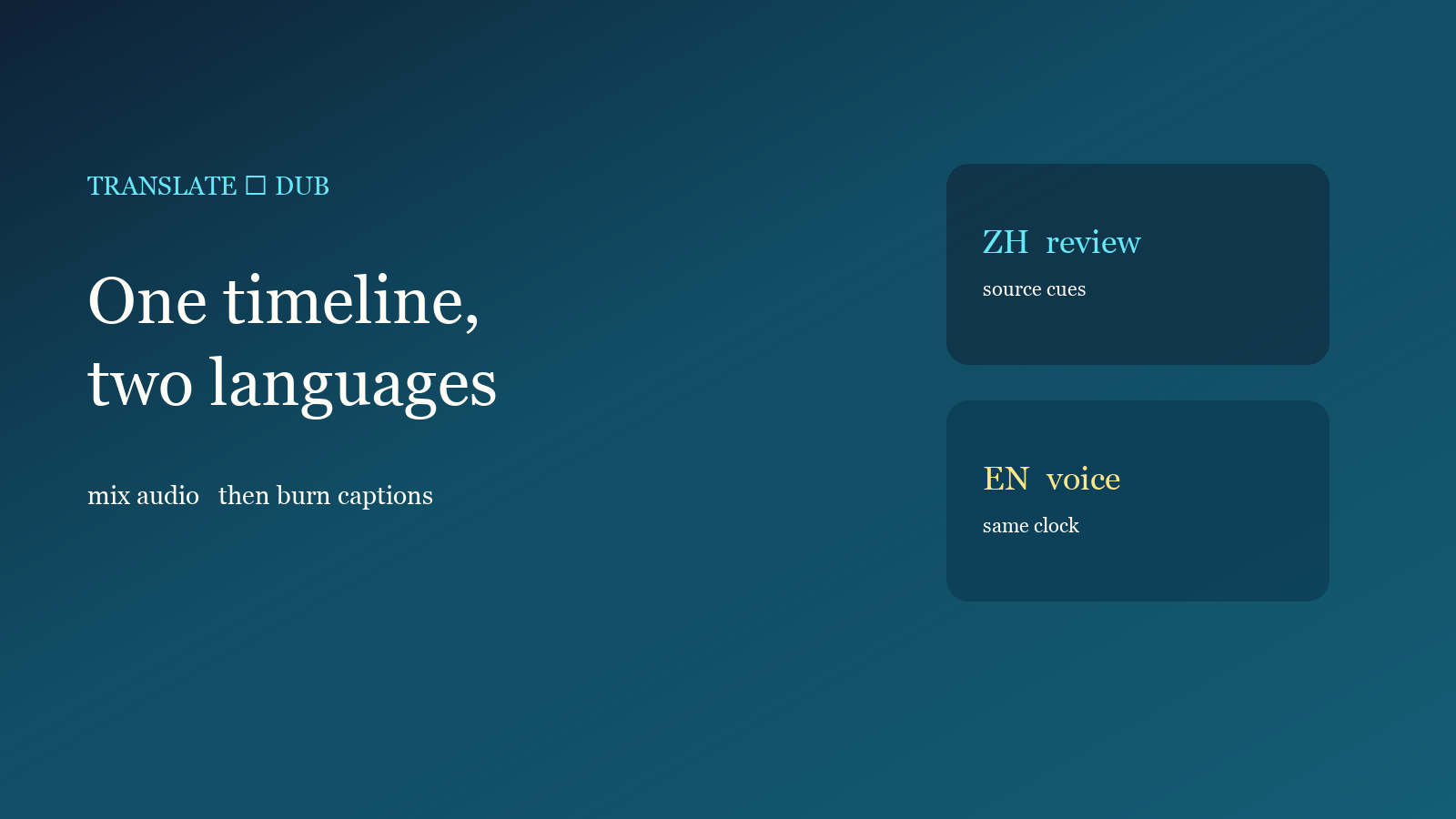
Overseas views need more than captions. If the platform can play a foreign voice, stacked translation alone feels like homework. In the studio the calmer path is: review the source cues, translate on the same timeline, then dub from the translation. Timestamps never move. Dubbing voices are Chinese 晓晴 and English; Japanese, Korean, German, French and Russian can be caption languages — spoken takes stay Chinese or English.
Translate the words, then speak
A dirty source axis scales mistakes in both translation and speech. Do not reverse the order:
- Build timestamped source captions (speech, burned-in OCR, or an imported SRT).
- Fix typos, names and breaths, then start translation.
- Review names and line length in the translation, then start dubbing.
- If you need burned-in type, mix the audio first, then burn. Do not burn and then dub.
The ten-minute caption path is in this guide. Bilingual captions without a new voice: translation.
A foreign cut on the same timeline
- Open translation in the studio with the current project or a local MP4 / MOV. The file stays in the browser.
- Confirm the source cues are reviewed. Tick caption translation. Pick English first when you want an English voice. One target language per run.
- Scan names and long lines. On 9:16, split past ~14 Chinese characters or a short English clause — see vertical layout.
- Open dubbing. English picks from several voices; Chinese back-translation uses 晓晴. Auto-detect splits Chinese and English lines.
- For a spoken foreign cut, turn original audio off so two languages do not stack. The picture stays locked to the source.
- Export the mixed soundtrack first, then burn the translated captions, or save that language as SRT / VTT.
The free plan includes one translation run and one dubbing run per month. Languages, voices and limits are on Features and Pricing.
Check only three things
- Names: match brands and model numbers to the source before the voice reads them.
- One breath per cue: when the translation grows, split the line or change in/out — do not drag the whole file’s speed.
- Original audio: off for a spoken foreign cut; leave it on if you only stack bilingual captions and keep the Chinese voice.
What usually breaks
Dub Chinese first, then translate: the voice still reads the source and the new lines miss the mouth. Translate, then dub. Caption-only Japanese, Korean, German, French or Russian has no matching voice engine — do not force an English voice to read those languages. Keep the Chinese original or cut a separate English version. Export a cover in the target ratio — see covers from the clip.
Done reading? Make one. Free quota is ready.